Trustworthy AI
for mission-critical systems.
I'm Dr. Ozgur Ural, a machine learning research scientist and senior software engineer at Avion, where I build real-time software for Level D flight simulators and lead the company's AI strategy and reference architecture. My research asks what it takes to trust a model: evidence of how it was trained and who owns it, robustness against attackers, and predictable timing when it runs inside a real-time loop.
Leiden, Netherlands. Interested in research scientist roles in ML and AI, and open to research collaboration, advisory and speaking.
Selected research & architecture
-
SecurePoL: Watermarking + Proof-of-Learning
Defends proof-of-learning against spoofing by making verification depend on a feature-based model watermark as well. Watch SecurePoL.
-
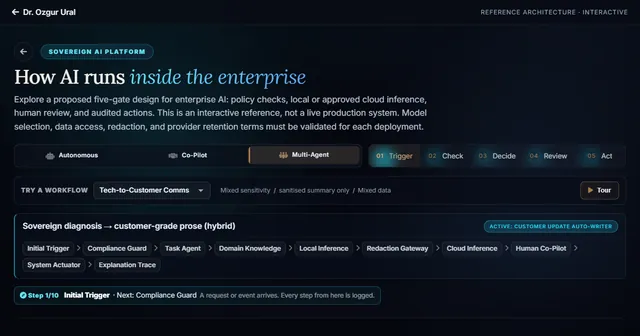
Enterprise AI strategy and reference architecture
The adoption roadmap and reference architecture I wrote for Avion, spanning on-premises inference, governed cloud APIs and edge workloads. The design distinguishes prototypes from proposed capabilities.
-
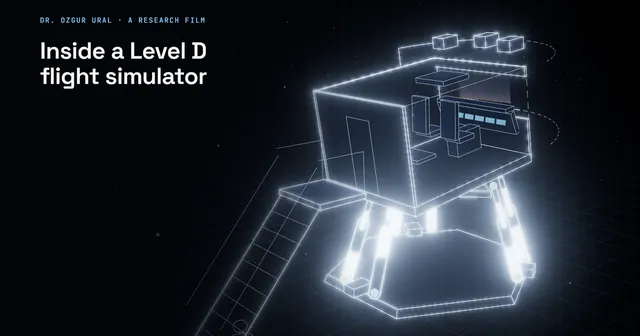
Inside a Level D flight simulator
How a certified simulator earns a pilot's trust, and what a learned model would have to keep to run inside its real-time loop. Every rule is cited from the regulation text.
-
Survey on Blockchain-Enhanced Machine Learning
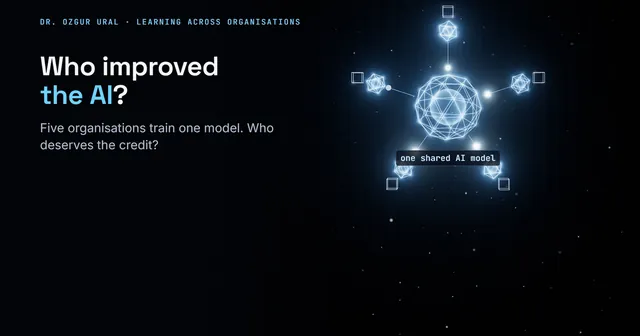
Reviews the design space where distributed ledgers meet learning systems. Watch collaborative AI.
Research agenda
Three questions, each from a system that has to work the first time. For each: the problem, what I have built or shown, and where it stands.
- Published · IEEE Access 2023–2025 · Ph.D. 2025
Proving how a model was trained, and who owns it
Models are bought, fine-tuned and shipped by people who did not train them. Proof-of-learning lets a trainer show the training was really done; a watermark lets an owner show a model is theirs. Each can be forged on its own.
My dissertation and SecurePoL study combine the two, so verification succeeds only when the training record and the watermark agree, and evaluate the result against specified spoofing attacks. Publications
- Open research direction of the author, not yet published
AI inside real-time, safety-critical loops
A flight simulator answers the pilot within 150 milliseconds, sixty times a second, for hours, and is certified on it. Learned models can make it more realistic, but their timing depends on the input and on whatever shares the processor.
Twelve years of hard-real-time and simulator software, from UAV mission control at STM to Level D simulators at Avion, behind one claim: a model earns a place in the loop only if every frame stays on time. The argument, as a film · an architecture experiment with asynchronous inference, expiry checks and fallback.
- In industry · Avion, 2026
Generative AI an engineering company can govern
In an engineering company the useful knowledge sits in its own documents and processes, and an AI system has to respect where that data is allowed to go.
I wrote Avion's AI adoption roadmap and a reference architecture spanning on-premises inference, governed cloud APIs and edge workloads, and built engineering-knowledge retrieval prototypes. Projects separates what is built from what is proposed.
Technical leadership & research practice
- Engineering Leadership
Direction, standards, teams
I lead Avion's enterprise AI strategy: the adoption roadmap and the reference architecture behind it. Before that I built mission-critical UAV software at STM and led the engineering team that shipped Havelsan's data-leakage-prevention product.
- Real-time & Fault-Tolerant Systems
Correct on time, and when parts fail
Real-time simulator software and the services around it (C, C++, Scala, TypeScript, gRPC), including a telemetry pipeline that sustains about 50 GB/s through batching and bounded-queue backpressure.
- Security, then ML Security
Thinking like the attacker
Seven years building security products (Comodo's secure web gateway and patch manager, Havelsan's DLP) before turning to ML security. A model earns trust by surviving contact with an adversary, not by scoring well on a clean test set.
- Research into Practice
Evidence a product team can use
I turn a research question into something a team can judge: reproducible experiments, working prototypes, and explainers for non-specialists, like the films in the Research Lab.
Experience
- 2023–now Senior Software Engineer, Avion Full Flight Simulators. Real-time simulation platforms and cloud-native infrastructure for Level D flight simulators. Since 2026 also the company's AI adoption roadmap and enterprise reference architecture, the platform presenting it, and engineering-knowledge retrieval prototypes.
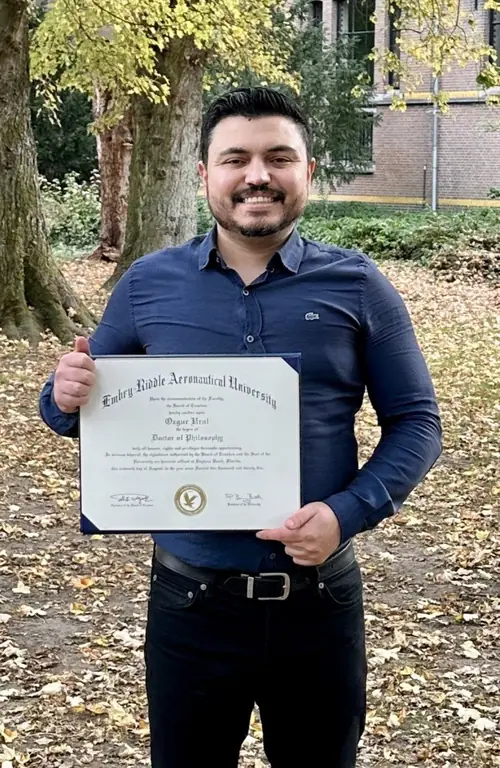
- 2021–2025 Ph.D. in Electrical Engineering & Computer Science, Embry-Riddle Aeronautical University (Graduate Research Assistant). Dissertation: Enhancing Proof-of-Learning Security Against Spoofing Attacks Using Model Watermarking, guided by Dr. Kenji Yoshigoe (Committee Chair) and IEEE Fellow Dr. Houbing Song. Three first-author IEEE Access papers, including SecurePoL (December 2025) with Dr. Yoshigoe after graduation. Dissertation · Verify diploma.
- 2020–2021 Software Team Lead, Havelsan. Led a 14-engineer team delivering the Havelsan DLP data leakage prevention product for defence and government clients.
- 2019–2020 Expert Software Engineer, STM Defence Technologies. Mission-control and ground-control systems for Kargu, STM's rotary-wing loitering munition in service with the Turkish Armed Forces, and the Togan reconnaissance UAV. Hard-real-time and safety-critical, where a missed deadline is a mission failure.
- 2014–2019 Expert Software Engineer, Comodo Cybersecurity. The Comodo Dome Secure Web Gateway, the enterprise Patch Manager and the Chromium-based Dragon browser, leading the design and development of Windows services and applications in C++.
- 2010–2014 B.Sc. in Computer Engineering, Middle East Technical University (METU). Turkey's most selective computer engineering program (English-medium), entered among roughly the top 1,000 of more than 2 million national candidates. Graduated with 1st prize at TÜBİTAK's national project competition and 2nd prize at the METU CENG graduation Demo Day.