Cockpit Discipline for Engineering Teams: What Competitive Sailing on the Aegean Taught Me About Leading Mission-Critical Systems
Published:
Every engineering program with a hard delivery window and a non-negotiable failure cost is a sailboat race. The water is not the Aegean; it is a requirements document, a CUDA driver bump, or an FAA qualification gate. The boat is not a J/24; it is a Level-D flight simulator program, a secure web gateway, or a proof-of-learning protocol. The crew is not seven undergrads in spray gear; it is a cross-border team of ML researchers, avionics test engineers, and regulatory specialists spanning Leiden, Daytona, and Ankara.
I raced for six years with METU Sailing Club across the three Turkish Aegean regatta circuits below. I do not race today. What I do carry is the playbook of a crew that finished top-five in the Jimmy Key Cup fleet after fixing a broken spinnaker pole in the water between courses, with no shore support, on a three-knot tide. That playbook runs every program I lead.
Three Regattas, Three Engineering Archetypes
The Turkish Aegean hands a racing crew three distinct failure modes. Each one maps cleanly onto a mission-critical engineering program I have run since:
Urla (home of the Aegean Offshore Yacht Club). Light, shifty afternoon thermals that die without warning on the home leg. The crew that banks a lead before 14:00 wins; the crew that sails conservatively and expects wind to hold finishes mid-fleet.
Engineering analogue: The Comodo Secure Web Gateway rewrite, 2016-2018. Traffic patterns shifted when the 2016 Dyn/Mirai variant hit European POPs. Teams that had already instrumented a 85%-utilization early-warning path in the ICAP forwarder survived; teams that sailed to the steady-state capacity spec burned out and shipped late. The Urla rule won that program: instrument the wind shift before the wind shifts.
Bodrum (BAYK Baykar Winter Trophy, sponsored by Baykar Tech). Gusts funneling down the hills between Yalıkavak and Gümüşlük hit the fleet on a five-minute cycle. Trimmers win this regatta. A helm that waits for a gust to arrive before feathering has already lost the mark rounding.
Engineering analogue: The Havelsan Data Loss Prevention program lead role, 2018-2020. Insider-threat profiles shift on a five-minute cycle too: a user whose baseline is 200 classified-document opens per day opens 1,200 in 40 minutes and the SOC needs a verdict, not a dashboard. The Bodrum rule won that program: trim the detector to the gust cycle, not the calendar quarter.
Marmaris (International Race Week). Long offshore legs from the marina to the Keçi adaları mark, spinnaker up, overnight scoring, and European crews who show up with real shore support budgets. The boat that keeps its spinnaker flying through the gybe set at 22:00, instead of dousing and re-setting, wins the overall. The penalty for a blown spinnaker in the dark is a lost regatta, not a damaged sail.
Engineering analogue: Avion Full Flight Simulators Level-D qualification programs, 2022-2025. The final 72 hours of a CAE- or FAA-style qualification run is a Marmaris gybe set in the dark. Every subsystem: IO boards, FMS, instructor station, visual, motion platform, has to land simultaneously in the acceptance window. One subsystem that “gets there eventually” sinks the whole delivery. The Marmaris rule won those programs: the gybe is a single choreographed move, not seven independent actions.
Seven Roles on a Race Boat. Seven Roles on a Mission-Critical Engineering Team.
On our boat I trimmed the jib for most races, but I rotated through every position on slow practice days. That rotation is what taught me how the parts fit. I now staff every engineering program I run with the same seven explicit roles, even when a single person holds two of them on a small team:
Helmsman / Program Manager. Steers the boat on the compass bearing the tactician picks. Calls the tacks. A panicky helm loses every pre-start; a calm helm wins races they had no business being in. In engineering: the named person who calls go/no-go on a release. I run this role at Avion on every Level-D simulator acceptance run; a shaky helm during those 72 hours is the single largest delivery risk.
Tactician / Chief Architect. Studies the fleet, the wind forecast, and the protest book. Picks the mark-rounding order that avoids the pile-up. Does not sail faster than the rules allow; sails the rules as part of the course. In engineering: the named person who reads the EASA CS document, the FAA AC, or the STANAG as an input to the architecture, not as an afterthought. My Embry-Riddle SecurePoL tactician role is what kept three IEEE Access papers out of the position-paper bin: every protocol decision traces to a named threat, not a research fashion.
Jib Trimmer / Core Platform Lead. That was me most days. Watches the leeward telltales more than the helm does. Feathers the sheet before a gust hits. A jib trimmer who waits for the helm to yell is already two boat-lengths down. In engineering: the lead engineer who owns the telemetry backpressure thresholds, the change-control board agendas, and the post-incident retrospectives before the incident happens. This is the role I hire into first on every program.
Mainsail Trimmer / Platform-Security Lead. Works with the jib trimmer, never against. Balances the helm’s weather-helm instinct with the tactician’s course. A mainsail trimmer who argues loses the race silently over ten legs. In engineering: the security lead who does not block release candidates; who sits inside the architecture reviews from sprint zero and ships signed watermark checkpoints, not review comments.
Bowman / Integration Test Lead. Leaps like a cat onto the foredeck in three-meter seas to set or douse the spinnaker. Works in the spray. Everyone else hears the call but the bowman lives it. In engineering: the engineer who runs the chaos-monkey turbulence drill every Friday, who revokes a checkpoint-signing key mid-epoch to verify the detector still trips. You cannot run a Level-D simulator or a SecurePoL release without a great bowman.
Pit / Release Engineering Lead. Coordinates lines, halyards, and the foredeck-aft handoff. The cockpit sees a clean spinnaker set; the pit sees twelve lines, five winches, and one window where nothing can tangle. In engineering: the named person who owns the signed release manifest, the dual-regime traceability matrix, and the change-control record that gets attached to every Avion qualification submission and every ERAU IEEE Access paper.
Navigator / Program-Scheduling + Regulatory Lead. Tracks every mile sailed against the tide table and the protest time-limit. Keeps the log that wins a jury if you are fouled. A navigator who only tracks GPS is a passenger. In engineering: the person who owns the “why is this late” story before the program is late. They map every regulatory citation, every EU GDPR data-residency requirement, and every FAA export-control classification into the sprint schedule, not the closing slides.
The Cockpit Discipline I Copy Into Every Engineering Program I Run
The lessons below are not “team building.” They are the habits that kept our boat from sinking on a 30-knot gust into Marmaris on the final night of Race Week 2014. They are the exact same habits that kept a 737 MAX Level-D simulator qualification on track during a 2023 CUDA driver bump and a 2024 ERAU SecurePoL submission on track when a grad student had to return to Ankara for four weeks mid-experiment:
Telltales are the boat’s heartbeat. Glance at them every few seconds. In sailing, you do not wait for the helm to tell you the sail has stalled; you see the telltails go horizontal first. In engineering, you do not wait for a Sev-1 incident ticket. You glance at the bounded-queue fill-percent every 90 seconds the way our Level-D simulator dashboards used to glance at CDU buffer fill. The SecurePoL Prometheus alerts are tuned to 85% queue fill for exactly this reason.
Communication beats heroics. Call your moves early and clearly. On the boat, “Ready about, helming to tack” comes ten seconds before the helm moves. The bowman is already on the foredeck when the helm calls tack. In engineering: “I am revoking checkpoint-signing key POL-07 at 14:30 UTC for the turbulence drill” comes ten minutes before the key rotates. No one learns about a change from a CI failure. The bowman does not learn about a tack from the tiller hitting his ribs.
If you have time to relax, you have time to coil a line. No one stands around on a race boat. Someone is coiling, someone is trimming, someone is updating the log. In engineering: the 20-minute window between sprint retro and the end of the day goes to writing a regression test, not scrolling. The Avion team shipped the 737 MAX FFS visual subsystem two weeks early because every “relax” 20-minute block went to a signed integration-test case.
Double-check every knot. Twice. A bowline that holds for two legs and slips at mark rounding 3 costs you the race. In engineering: a dependency hash that verified once at build time and then drifts by 0.001% after a node reboot costs you the SecurePoL IEEE Access submission. Double-check signatures, hashes, and wind knots. Twice.
Debrief in the parking lot, not the following week. The pasta dinner after a bad race is where the real correction happens. The log entry is written before anyone showers. In engineering: the post-mortem for a stuck-input bug on the Avion visual bus is written in the lab with the fault log still on screen, not at the next program review. The decision to double the jib-trim crew rotation after a Bodrum gust wipeout is the same decision that doubled the regression-suite coverage on the Havelsan DLP classifier.
Why This Line of Thinking Wins Regulated Programs
A prospect shopping for an ML security vendor or a flight-simulator integrator does not buy credentials from a CV. They buy the discipline the team has rehearsed under real pressure. They buy:
- The team that can explain why the 85% queue-fill alert is 85, not 90 or 70, with the same specificity a jib trimmer can explain why he feathered the sheet five degrees before the Bodrum gust arrived.
- The team that ships a dual-regime traceability matrix in sprint zero because the navigator tracked the protest time-limit before the race started.
- The team that runs a turbulence drill every Friday because the bowman practices spinnaker douses in the dark, not on sunny practice days.
That team is the one that finishes top-five at Marmaris with a field-repaired spinnaker pole on a three-knot tide. That team is the one I staff, the one I lead, and the one that wins regulated aerospace and AI-security programs when the pressure looks like a 30-knot Aegean gust at 22:00.
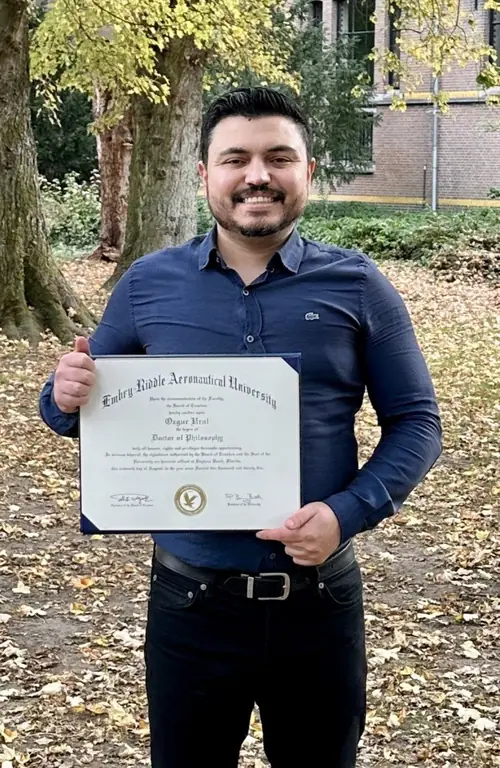
Dr. Ozgur Ural is a U.S.-PhD (Embry-Riddle) ML security researcher and senior software engineer with 11 years of mission-critical delivery. He runs regulated aerospace and AI-security programs using the explicit seven-role staffing model he learned racing with METU Sailing Club. Open to technical-advisor and program-lead engagements where cockpit-style discipline under live pressure is a delivery requirement.