Enhancing Proof-of-Learning Security Against Spoofing Attacks Using Model Watermarking
Published in Doctoral Dissertation, 2025
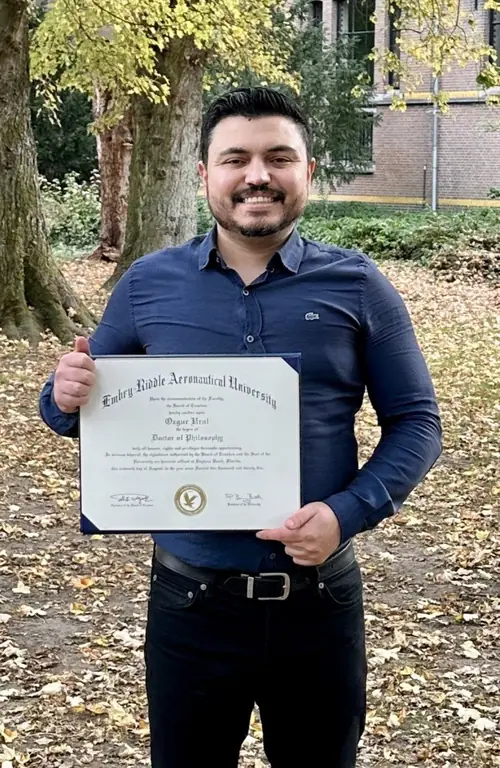
Doctoral dissertation, Ph.D. in Electrical Engineering and Computer Science, Embry-Riddle Aeronautical University (Daytona Beach, Florida). Advisor: Dr. Kenji Yoshigoe.
The attack it answers
Proof-of-Learning verifies the computational effort behind a trained model, but on its own it can be spoofed by attacks that manipulate its subset-verification pathways and tolerance parameters. The dissertation first shows how an adversary can replicate the computational trajectory of a legitimate model and, under surrogate-training conditions, even approximate an embedded watermark.
The framework
The proposed framework, SecurePoL, closes that gap by coupling PoL’s training logs with three orthogonal watermarking strategies: feature-based embedding, parameter perturbation, and non-intrusive auxiliary heads. Verification then becomes a joint condition, so a forger has to reproduce both an authentic training log and a watermark-consistent ownership signal, rather than either one alone.
What it costs, measured
On CIFAR-10 with ResNet-20:
- The computational effort required for successful blindfold Top-Q and infinitesimal-update attacks rises by more than an order of magnitude.
- Ownership verification costs almost no utility: baseline accuracy changes by +0.00 pp with feature-based watermarking, 0.03 pp with non-intrusive heads, and 0.58 pp with parameter perturbation.
Read the full dissertation in ERAU Scholarly Commons. The watermarking-plus-PoL construction is also published as SecurePoL in IEEE Access (2025), and there is an animated explainer in the Research Lab.
Cite this work
Ural, O. (2025). Enhancing Proof-of-Learning Security Against Spoofing Attacks Using Model Watermarking. Doctoral dissertation, Embry-Riddle Aeronautical University.
@phdthesis{ural2025dissertation,
  author    = {Ural, Ozgur},
  title     = {Enhancing Proof-of-Learning Security Against Spoofing Attacks Using Model Watermarking},
  school    = {Embry-Riddle Aeronautical University},
  year      = {2025},
  url       = {https://commons.erau.edu/edt/905/}
}